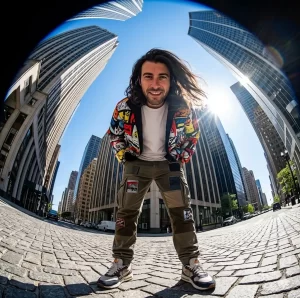
Generated with: Gemini
Prompt:
Use the uploaded image strictly for face and identity reference only. Lock facial identity with the highest priority. Do not beautify, stylize, or alter identity in any way.
Create a 4k resolution, 4:5 aspect ratio, high-quality digitally rendered watercolour-style portrait of a couple, presented inside a dark walnut wooden frame. The artwork must combine precise digital illustration with the soft, fluid characteristics of traditional watercolor painting.
- Subject Composition (Strict — Do Not Modify)
- Intimate bust portrait, cropped slightly below mid-chest.
- Male positioned on the left, female on the right.
- Their upper bodies angled very slightly inward toward each other.
- Shoulders gently overlapping, with the female subtly leaning into the male’s shoulder for a natural, connected feel.
- Heads placed close together with temples nearly touching.
- Both faces turned almost straight toward the camera with only a minimal inward rotation (very subtle 5–10° inward angle).
- Chin’s level and aligned at a similar height (no exaggerated tilt).
- Posture upright but relaxed — not stiff, not exaggerated.
- Expressions soft and warm:
- Male — calm, subtle, closed-mouth smile.
- Female — bright, open smile with gentle warmth.
- Eye contact is directed toward the viewer.
- No dramatic head tilt. No exaggerated lean. Keep connection natural and balanced.
- Adaptive Outfit Detection (Automatic From Reference)
- Carefully analyze the uploaded reference image and:
- Detect exact clothing type (shirt, blouse, jacket, saree, kurta, suit, casualwear, etc.)
- Preserve accurate fabric color, texture, and material type.
- Replicate neckline, collar style, sleeve length, layering, and visible accessories.
- Maintain realistic folds and garment structure.
- Do NOT replace clothing unless explicitly instructed.
- Enhance subtle fabric texture slightly for watercolor realism, while keeping authenticity.
- Carefully analyze the uploaded reference image and:
- Artistic Style & Watercolor Execution
- Medium Simulation:
- Blend wet-on-wet soft gradients in background.
- Use wet-on-dry precision around facial features.
- Allow organic pigment bleeding around edges.
- Maintain visible watercolor paper grain texture.
- Brushwork Detail:
- Fine strokes for eyelashes and individual hair strands.
- Controlled detailing around the eyes and lips.
- Broad translucent washes for clothing.
- Subtle pigment pooling and natural gradient transitions.
- Soft watercolour blooms around the outer edges.
- Do NOT over-sharpen or make it look like a digital painting — it must feel like genuine watercolor.
- Medium Simulation:
- Color Palette (Adaptive + Balanced)
- Maintain accurate skin tones from reference.
- Use soft warm neutrals (cream, beige, tan) as base tones.
- Introduce complementary cool washes when appropriate.
- Background should remain light, airy, and minimally dominant.
- Avoid heavy contrast or overly saturated tones.
- Lighting & Depth
- Soft, natural, diffused lighting from slightly above and front-facing.
- Gentle highlight across forehead, cheekbones, and nose bridge.
- Subtle shadow under the jawline and neck area for depth.
- No dramatic side-lighting.
- High-key, airy atmosphere.
- Enhance depth subtly while maintaining watercolor softness.
- Presentation & Framing
- Artwork displayed inside a dark walnut or espresso-finished wooden frame.
- Modern flat frame profile with subtle wood grain.
- No visible matting.
- Art extends near edges for a contemporary full-bleed look.
- Visible watercolor paper texture inside frame.
- Clean neutral wall mockup presentation.
- Frame is visible evenly on all four sides with centred wall alignment.
- Slightly Increased Quality Controls (For Better Results)
- Increase fine facial detailing by 15–20% while maintaining watercolor softness.
- Improve edge control around eyes and lips for clarity.
- Maintain subtle texture contrast between skin and clothing.
- Ensure both subjects remain equally sharp and balanced.